In the current era of rapid globalization and urbanization, chain convenience stores have long been part of people's daily lives. President Chain Store Corporation clearly understands that in addition to the impact on nature, our value chain activities also have a high degree of impact on natural resources. Therefore, protecting biological diversity is the embodiment of our environmental responsibility, as well as the key to sustainable development.
From 2022, President Chain Store Corporation passed the Biodiversity Policy and No Deforestation Commitment, promising all operating locations and our supply chain will follow the principles of biodiversity protection and no deforestation.
Please refer to the "President Chain Store Corporation Biodiversity Policy and No Deforestation Commitment".
"Biodiversity Policy" and "No Deforestation" Commitment
| "Biodiversity Policy" and "No Deforestation" Commitment |
Biodiversity |
No Deforestation |
| Scope |
All operating locations and the supply chain. |
| Target year |
Complete the process formulation and degree of quantifiable impact by 2025. |
Complete the process formulation and degree of quantifiable impact by 2025. |
| Net Positive Impact by 2050. |
No Net Deforestation by 2035. |
| No Gross Deforestation by 2050. |
| Execution Policies |
Commitment to include a biodiversity assessment in the system. |
Commitment to include a no deforestation verification mechanism in the system. |
| Principle |
Conducting a biodiversity risk assessment for the value chain by following the mitigation hierarchy, covering operating locations, supply chain and partners (manufacturers and franchisees), as well as selecting material issues based on risk levels, set measurable management goals, take mitigation actions, as well as publicly disclose relevant results and share them with stakeholders. |
Completion of inspections in order of levels and risks year by year with results published. |
| Requirement for the value chain to commit to avoiding operating activities in areas with important biodiversity at home and abroad. The value chain includes operating locations, supply chain, and partners (manufacturers and franchisees). |
Commitment to follow the principle of no net deforestation for our operating locations, areas adjacent to scope of our operations, supply chain, partners (manufacturers and franchisees) and stakeholder activities. |
| Commitment to play an active role in the value chain of President Chain Store Corporation, covering operating locations, supply chain and partners (manufacturers and franchisees). In addition to entrusting a third‑party ecological consulting company to assist in reducing damage to ecological resources with correction, minimization, or compensation measures, the goal of no net loss (NNL) is set in priority areas. |
Commitment that the Company will play an active role, participate in afforestation activities, and follow the principle of zero net deforestation. |
| Commitment to actively engage in biodiversity discussions with stakeholders to ensure that President Chain Store Corporation and all stakeholders move towards the goal of achieving a net positive impact by 2050. |
Commitment that the Company's operating locations and supply chain will meet the principle of zero gross deforestation by the target yea. |
| Commitment to engage in biodiversity discussions with stakeholders. |
"Biodiversity Policy" and "No Deforestation" Supplier Agreement
President Chain Store Corporation is committed to managing all suppliers with regard to "Biodiversity Policies" and "No Deforestation." In 2022, President Chain Store Corporation incorporated clauses on "No Deforestation & Biodiversity" into the "UNI-PCSC's Supplier Code of Conduct," strengthening raw material suppliers' focus on no deforestation actions and biodiversity. The content primarily includes requirements for suppliers not to clear forests by burning or logging, not to procure products from companies violating international laws or damaging conservation areas and peatlands, supporting biodiversity, and safeguarding the rights of farmers and workers. New suppliers have signed contracts under the updated terms, and future efforts will gradually expand management practices among suppliers, collaborating to achieve the vision of biodiversity protection and no deforestation.
Risk Assessment Procedure and Mitigating Action
Biodiversity Risk Assessment Procedure and Risk Level Definitions
In order to effectively implement biodiversity protection and mitigation actions for its own operations and surrounding areas, President Chain Store Corporation has established a biodiversity risk assessment process and has also incorporated biodiversity issues into its supplier risk assessment. To achieve a net positive impact on biodiversity across all 7-ELEVEN operating locations and continuously reduce the impact of its operations on the ecological environment, 7-ELEVEN has incorporated an “ecological self-assessment” into the process for new store establishment. This is intended to identify areas with high biodiversity risk and adopt corresponding nature-friendly measures to mitigate the impact of operations on the natural environment. Starting in 2024, we collaborated with an external environmental consulting firm to design the store ecological self-assessment process, and conducted a preliminary ecological impact assessment with reference to the concepts of the Taskforce on Nature-related Financial Disclosures (TNFD). Based on the LEAP approach, a series of ecological conservation and biodiversity-friendly strategies has been proposed for store operations across Taiwan, providing a foundation for the future implementation of diverse nature-friendly measures.
In order to identify operating locations with different risk levels, President Chain Store Corporation classifies its operating locations into low-, medium-, and high-risk areas based on risk classification definitions, and prioritizes actions for medium- and high-risk operating locations.
Biodiversity Assessment of Store Operations
Biodiversity Risk Level Definitions and Action Plan
| Risk Level Definitions and Action Plans |
| Level |
Definition |
Action Plan |
A
High risk |
The store is located in nature reserves, wildlife protected areas, important wildlife habitats, nature protected areas, national parks, national nature parks, conservation corridors in the Taiwan Ecological Network, involving important habitats for protected species or species classified as "Vulnerable" in the Red List of Taiwan |
If the store is located in an area of high commercial value and may affect biodiversity, it is recommended to reduce its scale and invite ecological experts and the consulting firm to develop countermeasures, such as relocating or abandoning the plan of store expansion to reduce ecological impact. Level A means that there are species that are easily affected by convenience store operations in the area, making it necessary to conduct professional assessment of the negative ecological impact, positive community benefits and store space. If all three conditions are met, it will be upgraded to Level A+ (for example, opening a store considering ecological friendly concepts) |
B
Medium risk |
The store is located in nature reserves, wildlife protected areas, important wildlife habitats, nature protected areas, national parks, national nature parks, conservation corridors in the Taiwan Ecological Network, without involving important habitats for protected species or species classified as "Vulnerable" in the Red List of Taiwan |
Adopting environmental friendly decor or actions, ecological education and promotion measures, as well as regularly holding relevant promotion or activities to enhance the environmental awareness of employees and customers |
C
Low risk |
Independent or street side stores located in commercial areas or non ecologically sensitive areas that are not in the aforementioned areas of concern with less impact on the environment |
The store is allowed to open as usual |
The result of Biodiversity Assessment
In 2025, President Chain Store Corporation conducted on-site assessments and surveys for all of its operating stores, totaling 7,248 stores. The assessment identified 617 stores located in operating areas with potential biodiversity impacts, while 2 stores were identified as operating in areas with actual impacts on biodiversity. These areas are rich in biodiversity, and the assessment indicated that the relevant stores need to strengthen environmental management measures to reduce potential impacts on ecosystems and promote sustainable operations.
| Item |
Number of Operating Sites |
Area of Operating Sites (Hectares) |
| Total number of operational sites |
7,248 |
116.57 |
| Operating sites subjected to biodiversity impact assessments (Assessment) |
7,248 |
116.57 |
| Operating sites with high potential for biodiversity impact(Exposure) |
617 |
11.026 |
| Operating sites affecting biodiversity with implementation biodiversity impact managing and monitoring systems (Management Plans) |
2 |
0.054 |
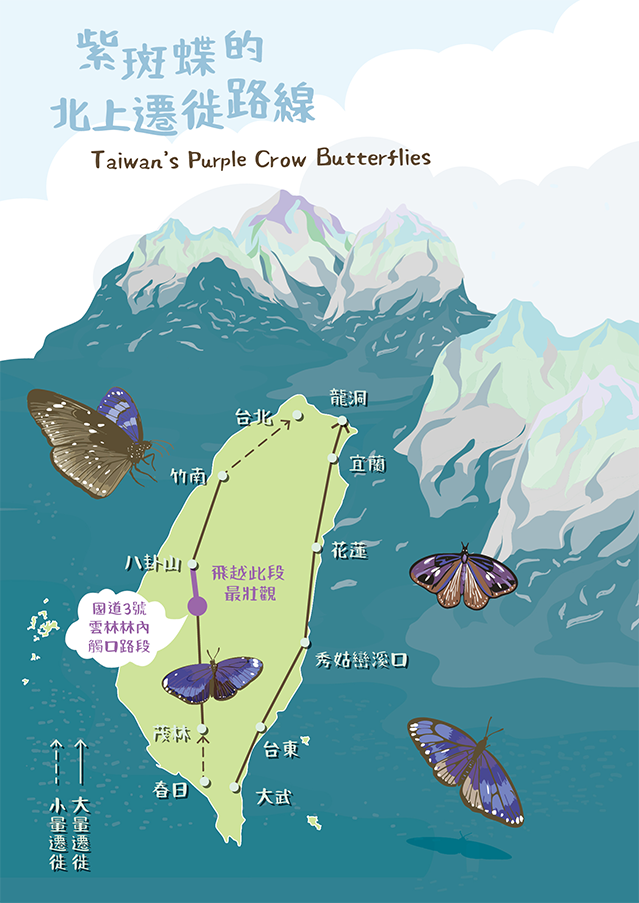
Based on the assessment results, President Chain Store Corporation selected the Youyu Store and Maolin Store for inspection and management in 2025, prioritizing avoidance and mitigation measures for these 2 stores identified in the assessment. The surrounding areas of the stores are important overwintering and migration areas for purple crow butterflies. To raise public awareness of purple crow butterfly conservation, President Chain Store Corporation collaborated with the Taiwan Purple Crow Butterfly Conservation Association to establish the stores as purple crow butterfly ecological demonstration sites, and will launch action plans and track their effectiveness. In addition, for the main findings of the on-site surveys and assessments conducted by experts and the related mitigation actions, please refer to the "5.1 Environmental Management" section on biodiversity management in the 2025 Sustainability Report.
| Youyu Store |
Maolin Store |
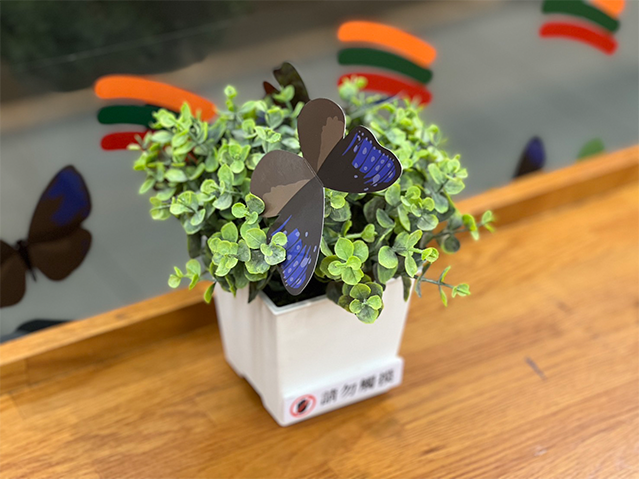
| Table stickers have been placed. Customers can scan to access information authorized and provided by the Taiwan Purple Crow Butterfly Conservation Association. The store operating space also incorporates purple crow butterfly imagery, with knowledge murals and themed visual designs planned, transforming the store into a demonstration site that connects environmental education with community exchange. |
Located near the internationally renowned "Purple Butterfly Valley," one of only two major overwintering valleys for milkweed butterflies in the world, the area welcomes the spectacular migration of purple crow butterflies from November to March each year. The store uses purple crow butterflies and mountain forest colors as its main visual theme, incorporating local Indigenous cultural elements. OPEN-Chan appears in traditional clothing, symbolizing visitors’ entry into a land rich in both cultural and ecological value. The store plans ecological window stickers, nectar plant cultivation, and ecological displays to provide purple crow butterflies with resting and foraging spaces. Through bird-safe glass design and environmental adjustments, the store also reduces the risks of window strikes and roadkill. |
 |
 |
Biodiversity Mitigation Hierarchy
- Avoid: President Chain Store Corporation has formally incorporated the ecological self-assessment mechanism into its store development governance framework. In addition to conducting ecological assessments for stores this year, the Company also included potential store sites planned for 2026 in the assessment. Even though these are not yet final site selections, biodiversity considerations are taken into account in advance. Before approval of any new store, location sensitivity identification and risk screening are conducted to confirm whether the site involves nature reserves, wildlife protection areas, national parks, the Taiwan Ecological Network, or important habitats of protected species and Taiwan Red List species. Avoiding operations in high-risk areas has become a key principle in pre-development decision-making, eliminating potential biodiversity impacts at the source rather than relying on remedial action afterward, and ensuring that the avoidance principle is embedded in the store development decision-making process.
- Reduce: President Chain Store Corporation has established a biodiversity risk grading and management framework for stores, completed risk identification for existing stores, and incorporated night-time lighting, transparent glass, waste treatment, vehicle concentration, and crowd gathering into the management scope of major operational impact factors. Current measures include bird-collision prevention design, the application of bird-recognizable patterns on glass, automatic dimming or lights-off mechanisms at night, the use of warm, low-color-temperature downward-facing lighting, and strengthened waste management, all aimed at reducing disturbance to species activity and environmental quality. Going forward, mitigation mechanisms will be progressively optimized according to site conditions so that operational impacts remain within a controllable range.
- Regeneration: President Chain Store Corporation promotes its "Sustainable Farm" program by recycling coffee grounds and surplus food from stores into organic fertilizer for agricultural use, thereby establishing a circular mechanism that enhances the biophysical functions and productivity of soil ecosystems. In addition to reducing waste burdens, this approach also strengthens the ecological resilience of agricultural landscapes. Going forward, store greening and microhabitat creation will be gradually promoted to support pollinators and enhance ecosystem service functions, shifting operations from merely reducing impacts to actively improving environmental quality.
- Restore: By introducing sustainable procurement mechanisms, such as sourcing FSC- and PEFC-certified paper packaging materials and coffee raw materials certified by the Rainforest Alliance, the Company reduces pressure on forests and natural resources associated with raw material sourcing, while supporting the maintenance and restoration of ecosystems in source regions. In the future, procurement will be gradually expanded to include products with lower chemical inputs, ecological or organic certifications, and products participating in ecosystem payment schemes. This will further link supply chain decisions with the maintenance of ecosystem services, strengthen responsibility for natural resource management at the production end, and establish a long-term mechanism to support ecological restoration.
- Transition: With reference to TNFD and based on the LEAP methodology, President Chain Store Corporation has established a framework for identifying nature-related dependencies and impacts, elevating biodiversity issues from site-level management to an institutional decision-making logic. In the future, this management framework will be progressively extended to supply chain management and product portfolio optimization. In alignment with the Satoyama Initiative, which emphasizes the linkage among production, ecology, and livelihoods, the Company will use sustainable procurement and product structure adjustments to guide consumer behavior toward lower greenhouse gas emissions and lower land and water resource intensity, thereby forming a systematic transition pathway that extends from operations to the value chain.