President Chain Store Corporation reduces loss of resources in four major aspects, including environmental and energy management, packaging material, waste disposal including food loss and waste, and water management. We aim at effectively using resources and reducing waste through the 3R principle, namely reduce, reuse and recycle.
Environmental and Energy Management
- Policy and Commitment
To realize the vision of green operations, President Chain Store Corporation has formulated "Environmental Policy", "Energy Policy", and "GHG Policy" as the guiding principles for the Company's actions on environmental issues. Based on the policies, President Chain Store Corporation realize sustainability in our operations and business model, making green consumption a part of daily life.
- Environmental Policy
President Chain Store Corporation is dedicated to becoming the leading retailer, providing the most convenient lifestyle services and fulfilling its responsibilities as a corporate citizen. Following the "President Chain Store Corporation Corporate Sustainability Development Code of Practice," the company has established a cross-departmental Sustainable Development Committee under the authority of the Board of Directors to address environmental issues arising from business operations, and report regularly to the Board. The Environmental Group, operating under Sustainable Development Committee, is responsible for managing environmental issues and incorporating the perspectives of external stakeholders in formulating and implementing environmental policies. President Chain Store Corporation, together with its affiliates, subsidiaries, key suppliers, and other partners, is committed to the following:
- Comply with environmental protection laws and regulations and prohibit any behavior that may harm the environment.
- Continuously improve our environmental protection performance, as well as optimizing our surrounding environment
- Cherish the use of resources and increase recycling and reuse, sticking to the principle of "making the most of resources."
- Endeavor to reduce the amount of waste based on the concept of "pollution prevention."
- With consideration to the environmental impact of our products and services in each phase of the life cycle from R&D, design, manufacturing, packaging to delivery, we will reduce resource consumption and increase the efficiency of resource use.
- Build up an eco-friendly value chain step-by-step, take environmental aspects into the selection of suppliers and key business partners (including but not limited to joint venture partners, licensees, and outsourcing partners) within the decision-making and processes of new project development and corporate mergers and acquisitions.
- Support community development and manage sustainable relationships with local communities.
- Promote environmental education and training, share environmental protection concepts with stakeholders like employees and customers in order to protect the environment together.
- Set short- and medium-term environmental management goals to actively reduce the negative impact on the environment from the production process to the value chain of distribution and logistics.
- In response to the Paris Agreement's global strategy of limiting global warming to within 1.5°C, we committed not funding climate-denial or lobbying against climate regulations, and achieving the net-zero emissions target for Taiwan's store operations by 2050.
Note:Please refer to the "Policies and Documents" page for the Environmental Policy.
- Energy Policy
As we strive to meet customer needs, we have made energy conservation and carbon reduction actions a core value of our business strategy. We use our stores as a base for energy conservation and carbon reduction by maximizing our advantage as a retail channel. We also exert our influence through the benefits of energy conservation. Our commitments:
- Complying with the government's energy laws and regulations and continuing to make energy improvements.
- Expanding stores with energy saving designs and developing and selling energy-efficient products.
- Optimizing our energy use to achieve sustainable corporate development.
| Energy Management Programs |
Management Actions in 2025 |
| Energy audits to identify opportunities for improving energy performance |
President Chain Store Corporation tracks electricity consumption of retail stores quarterly and sets annual Energy Use Intensity (EUI) targets for each store. This approach allows us to conduct energy audits on stores that have energy-saving potential or abnormal electricity consumption, thereby further improving energy performance.
|
| Quantified targets to address energy savings |
Our target to address energy saving is to achieve a 0.5% reduction in Energy Use Intensity (EUI) compared to the previous year, while the performance EUI value decreased by 2.65% in 2025.
|
| Actions to reduce the amount of energy use |
The Company has formulated basic requirements for equipment and store environment management for new and existing stores to improve energy efficiency by incorporating energy-saving designs :
- Heat insulation
- Energy saving signboards
- Lamp reduction
- Reduction of window area
- Frequency conversion system
- LED lamps installation
- Energy-saving windbreak room
Existing stores are actively evaluating the feasibility of implementing various energy-saving measures and gradually replacing equipment with high-efficiency alternatives.
|
| Evaluation of progress in reducing energy consumption |
In 2025, President Chain Store Corporation's retail stores successfully saved 95,668,216 kWh of electricity through energy-saving projects, which is equivalent to reducing indirect emissions of 45,347 metric tons of CO2e.
|
| Use of clean or green energy |
President Chain Store Corporation installed a 320 kW rooftop solar photovoltaic system at a logistics center to wheel green electricity to the convenience store headquarters building and selected stores. The system officially began wheeling electricity in March 2025, and the Company obtained 335,000 kWh of Renewable Energy Certificates from the Bureau of Standards, Metrology and Inspection, Ministry of Economic Affairs. President Chain Store Corporation has already introduced a solar photovoltaic system at the Yawan Store for direct store use. In 2025, renewable energy use reached 364.18 MWh, and the Company is gradually transforming towards a low-carbon economy.
|
| Investments in innovation or R&D to decrease energy consumption |
President Chain Store Corporation has invested in energy-saving and carbon-reduction measures in our stores by 2025, with a total investment of NT$403,494,376
|
| Energy efficiency training provided to employees to raise awareness of energy consumption reduction |
"In-store energy-saving and carbon reduction measures" are communicated to store employees and franchisees, reaching a cumulative total of 220 person-hours by 2025.
|
- Net Zero Commitment and Emissions Reduction Policy
As a member of the global village, President Chain Store Corporation lays great emphasis on the use of energy and resources, as well as the environmental impact. To fulfill our corporate responsibilities, we will control and manage the current status of greenhouse gas emissions and promote energy-saving and carbon-reduction plans based on the result of the inventory. President Chain Store Corporation has committed to achieving net-zero for Scope 1 and 2 greenhouse gases within its operations by 2050.
- Environmental Management System Certification
President Chain Store Corporation’s environmental management procedures for its operating locations are established in accordance with the framework of the international standard ISO 14001, ensuring that environmental management from headquarters to stores complies with the Company’s environmental policy and relevant regulations. In 2025, in addition to continuously maintaining ISO 50001 Energy management systems — Requirements with guidance for use certification for its headquarters building, the Company also obtained ISO 14001 Environmental management systems — Requirements with guidance for use certification, setting a benchmark for its environmental management procedures. Starting in 2025, President Chain Store Corporation also launched an internal audit process for store environmental management to proactively manage the energy and resource use at its operating sites. The Operation Planning Department is responsible for distributing store self-assessment checklists in a coordinated manner, and each store returns the completed checklist to headquarters. Relevant units then conduct follow-up management based on the self-assessment results. The self-assessment questionnaire covers topics including the management and flow of unsold food waste, implementation of environmental issue awareness initiatives, equipment maintenance and repair, and water quality testing. In 2025, a total of 1,043 operating locations completed internal audit management. In addition, headquarters commissioned regional consultants to conduct planned store visits and inspections covering six major environmental management themes. After each inspection, store personnel and franchisees sign to confirm the results, which are also reviewed and countersigned by the district manager.
| Environmental Management |
2025 |
Percentage |
| Obtained International ISO 14001 Environmental Management System Verification |
1 |
0.01% |
| Number of sites that passed other Third-Party certification (ISO 50001 Energy management systems — Requirements with guidance for use) |
3 |
0.04% |
| Number of sites that completed internal audits |
1,043 |
13.97% |
| Total number of sites |
7,468 |
14.02% |
- External Assurance
Packaging Material Management
To respond to the trend in plastic reduction and stakeholders' concerns about packaging materials, President Chain Store Corporation continues to stay updated with the Global Plastics Treaty. Although there was no progress after the fourth round of negotiations in 2024, President Chain Store Corporation has prepared in advance with the Plastic Reduction Task Force taking charge of management, as well as proactively taking actions to ensure that the use of plastic is gradually reduced in cooperation with consumers and suppliers in accordance with the Ministry of Environment's plastic reduction regulations. A comprehensive management policy has been established for the packaging and packaging materials of its private-label products, with the goal of reducing the use of virgin plastic by 30% compared to 2019 by 2030 and converting 50% of its private-label product packaging and materials to environmentally friendly materials. President Chain Store Corporation has also taken more active plastic reduction management actions, combining its private-label products and services, logistics, e-commerce and other operations strategies, in order to achieve the vision of completely eliminating other single-use plastic in its operations by 2050.
- Private-Label Products Packaging Materials Policies and Commitments
- The procurement of eco-friendly, certified packaging materials and lightweight packaging should be prioritized in consideration of environmental and ecology protection, while achieving sustainable operations. A target for packaging reduction for private-label products has also been set.
- To achieve source reduction and reduce plastic use, the Company aims to lower the proportion of other single-use plastics to below 10% by 2028.
- Ice makers have been introduced to reduce the use of plastic bags for ice packaging. By 2025, a cumulative total of 4,604 stores had adopted ice makers, resulting in a total plastic reduction of 305.70 metric tons.
- Sealing machines have been introduced to reduce the use of single-use cup lids. By 2025, a cumulative total of 5,200 units had been installed, resulting in a total plastic reduction of 294.85 metric tons.
- President Chain Store Corporation worked with President Packaging Ind. Corp an affiliated company, to establish and develop circular cup renting services to transit from manufacturing single-use containers to developing reusable containers:
- In response to regulatory requirements, the Company introduced a reusable cup rental service. By 2025, the service had been adopted at 2,528 stores, exceeding the target of 2,500 stores. The percentage of customers bringing their own cups reached 21.75%, achieving the annual target of 21.00%.
- We also encourage the consumers to use reusable packaging materials (or containers). A reward is also given for consumers who use their own reusable cups for freshly-prepared beverages. President Chain Store Corporation responded to the regulation in advance, bringing own reusable cup according to the regulations of the Environmental Protection Administration will entitle the customers to a discount of NT$5. Moreover, on the first of each month, bringing own reusable cup for “CITY” brand freshly-prepared beverages will entitle them to an NT$7 discount.
- In 2025, the paper cups used in stores adopted FSC-certified paper packaging materials.
- President Chain Store Corporation has set up Plastic Reduction Task Force as an internal cross-functional team to consolidate the Company’s efforts in plastic reduction. By combining the power of internal employees and external suppliers, Plastic Reduction Task Force promotes packaging plastic reduction strategies, targets, and action plans, while holding regular meetings to ensure the progress of each actions. The task force took about NT$2.5 million each year in manpower and testing resources, such as task force operations, R&D, testing costs in manpower and raw materials. The Plastic Reduction Task Force also stays on top of information on external competitiveness and the industry with the assistance of consulting company.
- Plastic Reduction Target
| Target Year |
Target |
| 2025 |
- Proportion of other single-use plastic being less than 18%.
|
| 2028 |
- Proportion of other single-use plastic being less than 10%.
- Eliminate disposable shopping bags and plastic straws (Note).
|
| 2030 |
- The packaging and packaging materials of the private-label products, with the goal of reducing the use of virgin plastic by 30% compared to 2019 by 2030, and converting 50% of the private-label products packaging and materials to environmentally friendly materials
|
| 2050 |
- Completely eliminate other single-use plastics (0%).
|
Note: In line with the Ministry of Environment's policy, President Chain Store Corporation no longer offers plastic bags, straws and net bags for takeaway. The targets above are imposed for occasions when consumers ask for straws, purchase plastic bags and net bags. In the future, plastic bags and straws for takeaway will no longer be provided or will be replaced by non-plastic ones.
- Plastic Reduction Task Force Missions
| Plastic Reduction Task Force |
Missions |
| Coffee Division |
- Reduce the packaging of freshly-prepared beverages, and introduce incentive scheme for reusable cups service, encouraging consumers bring their own cups and use the reusable cups
|
| Fresh Food Division |
- Reduce the weight of plastic used in fresh food packaging and increase the percentage of paper containers
|
| Product Division |
- Communicate with suppliers in the value chain, and introduce products with lightweight plastic containers
|
| Operations Division |
- In-store recycling mechanism optimization and store employees’ awareness of plastic reduction build. Introduce Intelligent Automatic Recycling Machine service
|
| Procurement Division |
- Procurement of store supplies, weight reduction for cutlery, development and introduction of alternative materials. Optimization of packaging weight reduction
|
| Public Affairs Division |
- Internal and external communications, raising awareness for consumers
|
| Human Resources Division |
- Internal education and training to increase the awareness of plastic reduction
|
| Administrative Service Division |
- Internal plastic reduction action planning
|
| Collection Service Division |
- Reduce paper used in collection services, reducing packaging weight for My Ship deliveries, and introducing eco-friendly materials
|
| Marketing Division |
- Collaboration and communications with private-label suppliers, development of alternative materials and optimization of packaging weight reduction
|
- Plastic Reduction Management Actions
President Chain Store Corporation has engaged in three aspects to reduce plastic, including "reduction at the source," "innovative packaging" and "encouraging customers to bring their own containers" since 2019. The Plastic Reduction Task Force was set up in 2020 to integrate strategies related to plastic reduction. We have started with the reduction of single-use plastics in private-label products and services, redesigned product packaging to reduce plastic consumption, introduced certified paper materials and recycled plastics, as well as reducing single-use containers by offering. In addition, President Chain Store Corporation integrated Group resources to set up the "OPEN iECO® Recycled Cups Renting Service" in 2022. By the end of 2025, a total of 2,528 stores have been incorporated with the hope of providing convenient services while working towards environmental protection.
Reduction of single-use plastics - Promotion of reusable shopping bags, and reduction of single-use cutlery and plastic packaging for fresh food
【Description】
- Reusable shopping bags made with 100% recycled plastic
【Case】
- President Chain Store Corporation continued the "100% recycled PE shopping bag" launched in 2024. The shopping bag is made from 95% recycled plastic and 5% recycled plastic from used milk bottles. In 2025, high-recycled-content shopping bags continued to replace virgin plastic single-use shopping bags, reducing the use of new plastic by approximately 753.2 metric tons. Among them, sales of large bags reached approximately 54.36 million units, which is estimated to reduce the use of new plastic by an average of approximately 52.1 metric tons per month. Extra-large bags have been sold since July, with sales of approximately 5.43 million units, reducing the use of new plastic by an average of approximately 21.3 metric tons per month.
Increasing the use of reusable packaging- Provide "OPEN iECO® Recycled Cups Renting Service" and Bring-Your-Own-Cups discount.
【Description】
- The store has set up an"OPEN iECO® Recycled Cups Renting Service" machine to reduce the use of disposable beverage cups
- Provide a discount for bringing your own cup that is better than the regulations
【Case】
- In 2025, President Chain Store Corporation has introduced the service to 2,528 stores, exceeding the regulatory requirements, providing the largest recycled cup renting service for a single channel.
- Through the efforts of diverse promotional activities, a cumulative plastic reduction of approximately 120.83 metric tons is projected by 2025. The overall plastic reduction benefit is estimated at around 100.73 metric tons.
Increase recyclable packaging
【Description】
【Case】
- The Company has completely replaced PLA boxes for tea eggs with recyclable PET material
- Coffee lids material changed to PET
- Reheatable fresh food containers are made of PP
Upgraded recycling mechanism
【Description】
- The store has set up "Intelligent Automatic Recycling Machines", increasing the recycling volume, also ensureing that resources can be recycled and reused.
【Case】
- Intelligent Automatic Recycling Machines: The Company continued to expand the scale of deployment in 2025, bringing the cumulative number of installed machines to 290. A cumulative total of 28.61 million PET bottles and 5.21 million used batteries had been collected through the Intelligent Automatic Recycling Machines.
Allocation of R&D resources to sustainable packaging solutions
【Description】
- Plastic Reduction Task Force promotes packaging plastic reduction strategies, targets, and action plans, while holding regular meetings to ensure the progress of each actions. The task force took about NT$2.5 million each year in manpower and testing resources, such as task force operations, R&D, testing costs in manpower and raw materials.
Adoption of plastics with recycled content
【Description】
- Recycled materials are used to replace virgin plastic for packaging materials
【Case】
- Recycled plastic (rPET) food containers are used in specific items, including mixed vegetable salad, mixed seaweed salad, Japanese Inari sushi and tuna and pork floss, etc. adopting packaging containing 30% plastic with recycled content.
2022-2025 Statistics of Plastic Packaging Materials
2022-2025 Statistics of Non-Plastic Packaging Materials
- The scope of statistics extends to President Chain Store Corporation's private-label product packaging, packaging of retail store products and services and for delivery purposes. The statistics of plastic packaging materials cover 100% of private-label products; the statistics of non-plastic packaging materials cover 100% of private-label products.
- FSC-certified items include refrigerated beverages, disposable chopsticks provided in-store, and coffee stirrers.PEFC-certified items include paper bowls, and recycled paper items include coffee cup holders.
Waste, Food Loss and Waste Management
- Policies and Commitments
Due to the service of convenience stores, waste generated mainly includes general waste and food waste. Waste management has gradually become an unavoidable and significant issue for President Chain Store Corporation. To effectively manage waste generated from operations,we have established "President Chain Store Corporation Waste Management Policy", developing medium to long term targets, strategies,and management actions:
| Waste Management Programs |
Management Actions in 2025 |
| Waste audits to identify opportunities for improving waste performance |
The Company conducts waste statistics audits each year to understand the main sources of waste generation that are closely related to store operations, including food waste and general domestic waste generated by store services. In addition to the waste from our operations, we also attach great importance to the waste management of fresh food manufacturers in the upstream of the value chain. We regularly count the food waste generated by the manufacturers and track the food waste disposal to identify opportunities for improving waste performance. Based on waste statistics, we have taken the specificities of the food retail industry into consideration to focus on the management of food waste and packaging materials for waste reduction.
|
| Action plans to reduce waste generation |
- Convenient Recycling Platform: Recycling PET, electronic waste, including batteries, laptops, optical discs, mobile phones and chargers.
- Store Equipment Reuse: The recycling system works on existing equipment from renovated and shut down stores, such as air conditioners, refrigerators, oden cooking machines, microwave ovens and so on. It is returned and put to use after inspecting, cleaning and repairing.
- iLove Food Program: A 35% discount is given 8 hours prior to expiration on over 100 products to reduce food loss and waste.
For more actions regarding waste reduction, please refer to 2025 President Chain Store Corporation Sustainability Report - 5.4 Food Waste and Waste Management
|
| Quantified targets to minimize waste |
- Food loss and waste: Commit to halving food waste discarded by 2030 as the target (with 2019 as the base year for the amount of food waste from the stores and manufacturers)
- Waste: Reduce the volume of waste removal from a single store by 45% in 2028, reducing by 20% in 2025; reducing by 25% in 2026(with 2019 as base year).
|
| Investment in innovation or R&D to minimize waste |
The Company promotes packaging plastic reduction strategies, targets, and action plans, We allocate about NT$2.5 million each year in manpower and testing resources. We continue to introduce circular economy initiatives to achieve waste reduction, including iLove Food Program implementation, developing "OPEN iECO® Recycled Cup Return Machine" for recyclable packaging, installation of "Intelligent automatic recycling machines", and establishment of customer incentives for recycling. Please refer to 2025 President Chain Store Corporation Sustainability Report 5.4 Food Waste and Waste Management for future related investment and R&D to minimize waste.
|
| Waste reduction training provided to employees |
- All employees and store franchisees took part in the "Plastic Reduction Digital Course" for a total of 1,476.77 person-hours in 2025.
|
| Integration of recycling programs to reduce the waste sent to landfill |
- Sustainable Farm: We collect stores’ near-expiry, opened, and discarded food items, along with coffee grounds, and process them through black soldier fly automated breeding equipment to convert them into organic fertilizer, which is then used for the cultivation of contract-farmed crops, finally returning to stores as fresh food side dishes or fresh produce for sale. In 2025, the Company promoted a coffee grounds resource recycling program, collecting coffee grounds from 100 stores in central Taiwan with a total recovery of 4.3 metric tons, successfully converting them into 6.4 metric tons of organic fertilizer. These were used to grow crops such as lettuce, carrots, bananas, and corn, which are then supplied back to stores, allowing more consumers to take part in and support sustainable diets.
- Intelligent Automatic Recycling Machines: The "Intelligent Automatic Recycling Machines" crush PET bottles and aluminum cans into flakes, effectively reducing volume by up to 75%, increasing the recycling volume per unit of space and minimizing the transportation carbon footprint. The scale continued to expand in 2025, bringing the cumulative number of installed machines to 290. In 2025, a cumulative total of 28.61 million PET bottles and 5.21 million used batteries were collected.
|
| Waste diversion from landfill is certified by an independent accredited body |
The total volume of waste generated by President Chain Store Corporation in 2025 was 56,119.87 metric tonnes, of which 4,134.67 metric tonnes went to landfills (Note 1). The remaining volume was diverted to animal feed/compost, incineration (including energy recovery) and recycling. President Chain Store Corporation diverts over 90% of its buried waste. (Note 2)
|
Note(1):The total weight of waste and waste for landfill has been disclosed in 2025 Sustainability Report. The 2025 Sustainability Report passed SGS verification and obtained AA1000 Type Two High Level assurance.
Note(2): Calculation of the diversion rate of buried waste: total weight of diverted waste/(weight of diverted waste + weight of buried waste) x 100%. The diversion rate of landfill waste at President Chain Store Corporation is greater than 90%.
- Food Loss and Waste Management
President Chain Store Corporation announced the target of halving food waste by 2030 in 2020 (compare with annual volume and reduction ratio of food waste from the stores and factories in base year 2019), President Chain Store Corporation took a detailed inventory to find out where food waste went and started implementing four metrics in 2021, including reducing the amount of scrapped fresh food year by year, reducing production loss at the manufacturers, reducing loss during logistics operations, and increasing the recovery of food waste in the stores. We will continuously initiate programs to reduce food loss and waste at the source in the three stages of production, order and delivery, as well as retail.
- Upgraded iLove Food Program and Reducing Food Loss and Waste with Technology
As the leader in the retail industry, President Chain Store Corporation is committed to reducing food waste. President Chain Store Corporation launched the iLove Food Map in the app in 2022 for consumers' easy access to the iLove Food availability in each store, allowing them to take advantage of the convenient program. In 2025, iLove Food prevented the generation of 20,472.50 metric tons of food waste with an increase of 2,605.56 metric tons from 2024. In addition to working together with consumers to reduce food waste, we extended the shelf life of food in 2025 by taking advantage of new technologies, such as the high-temperature sterilization equipment and special sealing film to reduce food waste from overstock.
- Coffee Grounds Recycling Program Promotes Circularity
To continue advancing a sustainable circular economy, in 2025 President Chain Store Corporation has continued to promote its coffee grounds recycling project. Coffee grounds were collected from 100 stores in central Taiwan, with total recovery reaching 4.3 metric tons. These were successfully converted into 6.4 metric tons of organic fertilizer, all of which was distributed to six contract sustainable farms working with President Chain Store Corporation to grow crops such as lettuce, carrots, bananas, and corn. These crops are then supplied back to stores, allowing more consumers to take part in and support sustainable diets while putting resource circulation and environmentally friendly goals into practice.
- Xinhu Farm Aquaponics: Circular Flavor from Farm to Table
President Chain Store Corporation supports eco-agriculture that balances environmental sustainability with innovation. Working with Xinhu Cooperative Farm in Yunlin County, the Company pioneered the cultivation of strawberries using Taiwan’s only fishpond-based modified aquaponics system, creating a circular agricultural ecosystem in which "vegetables feed the fish, fish nourish the water, and water nurtures the strawberries." By building greenhouses beside abandoned fishponds, the farm uses leftover trimmed vegetable leaves to feed fish, then recirculates fishpond water for strawberry cultivation. In addition, we also work with suppliers at the production stage to incorporate discarded outer leaves generated during the cultivation of two salad products under the One-Day Vegetable series, which sells 6 million boxes annually, into the aquaponics system as fish feed. The aquaponics system is also used to grow red sorrel, which is featured in the Smoked Salmon and Scallop Salad under the premium salad brand Salad Mood, bringing consumers freshness and flavor.
- Waste Management
The waste produced by President Chain Store Corporation is mainly domestic waste, which belongs to the general waste and general industrial waste as categorized by the Ministry of Environment with no hazardous industrial waste. The generation of bulk waste is closely related to store operations, including operational waste from upstream fresh food manufacturers, general waste (food waste, general household waste, etc.) generated by store services, and recyclables materials from the stores' reverse logistics mechanism, etc. To this end, President Chain Store Corporation has set clear targets for waste reduction while tracking the performance on an annual basis. To reflect the feasibility of the reduction plan, we reviewed the waste reduction target and adjusted the original reduction target in 2025: by 2028, the waste collection volume of each store will be reduced by 45%; the 2025 target is to reduce the waste collection volume of each store by 20% (with 2019 as the base year). President Chain Store Corporation follows the 3R principles in the overall waste management strategy to reduce, recycle, reuse, as well as minimizing non-recyclable waste. In terms of our own operations, we are concerned about the impact of plastic on the environment that is difficult to decompose and fulfill our corporate social responsibilities. To this end, President Chain Store Corporation engages in three aspects to reduce plastic, including "reduction at the source," "innovative packaging" and "encouraging customers to bring their own containers," as well as expanding the recycling mechanism in the stores to gradually decrease the dependence on single-use plastic and ensure proper treatment of waste from our operations. We are also actively concerned with waste from the downstream waste of the value chain by combining "convenience" and "recycling" through our many bases. To this end, we recycle PET bottles with Intelligent Automatic Recycling Machines, help people recycle information waste, and turn waste into resources to fulfill our social responsibilities.
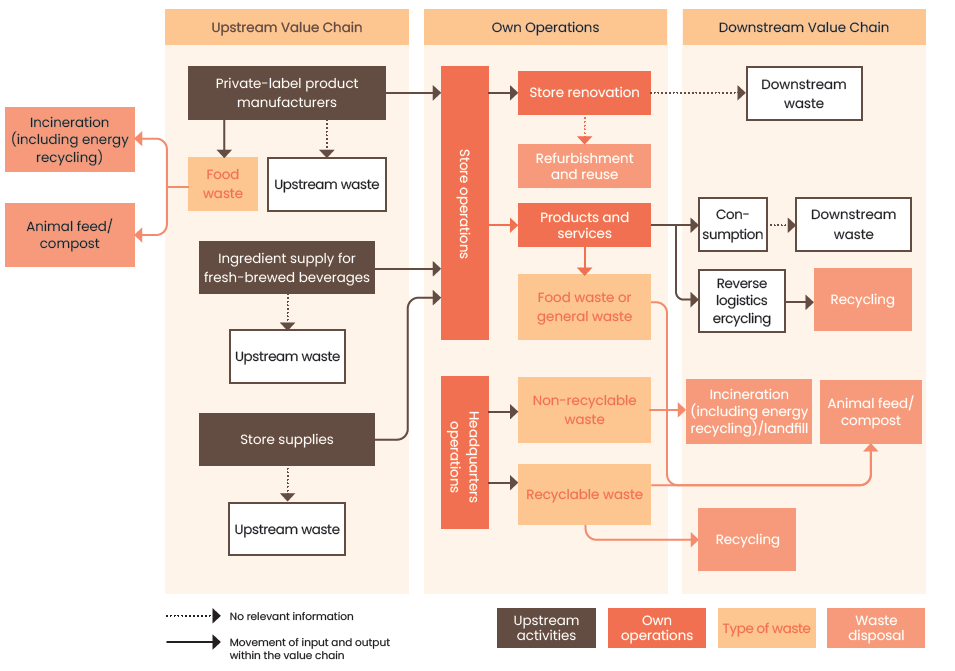
- Convenient Recycling Platform
Additionally, President Chain Store launched the Intelligent Automatic Recycling Machine to recycle PET bottles and batteries since 2022. In 2025, the company continued to expand its recycling initiatives, reaching a total of 290 machines installed and collecting a cumulative 28.61 million PET bottles and 5.21 million batteries. The recycled PET materials are then entrusted to specialized manufacturers for processing into recycled materials, which can be used to create store uniforms or merchandise sold back in stores. Simultaneously, the Company is collaborating with major PET bottle manufacturers to establish a "bottle-to-bottle" closed-loop recycling system in central and southern Taiwan and outlying islands. This system utilizes advanced technology to transform collected PET bottles into new ones, fostering a sustainable, closed-loop supply chain.
- Store Equipment Reuse
In order to provide the convenient products and services, President Chain Store Corporation relies on a large number and variety of machines. As the wear and tear as well as out-of-service machines cause a great burden on the environment, we have made good use of our flexible dispatch system and a great number of stores to set up the Equipment Refurbishment Center. The recycling system works on existing equipment from renovated and shut down stores, such as air conditioners, refrigerators, oden cooking machines, microwave ovens and so on. It is returned and put to use after inspecting, cleaning and repairing to reduce waste of resources and waste generation, while also saving on equipment procurement costs. In 2025, 31 types of equipment were refurbished and put to use, with the total number of 3,207 machines and saving a total amount of equipment procurement costs of NT$103,870,524.
Water Resource Management
- Water Efficiency Management Programs
Water supply and quality have a direct or indirect impact on the business model of chain stores regarding the products and services we can provide to the consumers. Especially in areas with tight water resources, how to reduce the operational impact on the local water resources is critical in overall operating value chain.
| Water Efficiency Management Programs |
Management Actions in 2025 |
| Water use assessment to identify opportunities for water efficiency improvements |
President Chain Store Corporation conducts an annual inventory of water use across its operating locations to further identify key water-use hotspots. In 2025, the Company’s total water withdrawal was 3,779,783.43 cubic meters, and total water consumption was 153,534.92 cubic meters. The reporting scope includes stores, headquarters, shopping malls, and district offices. According to the water-use assessment results, water is primarily used for freshly prepared beverages and cleaning in stores. Water-saving measures and RO recycling equipment have been introduced to conserve water, and resources have also been invested to improve water-use efficiency.
|
| Actions to reduce water consumption |
The Company has taken the following actions to reduce water consumption:
- Adopt water saving equipment in operating locations, such as water saving faucets and toilets.
- Introduce RO water recycling and rainwater collection equipment.
- Establish a mechanism for repairing abnormal water leaks and reporting them in a timely manner at operating locations to reduce water waste caused by water leaks. A total of 3,707 water leak repairs will be completed by 2025.
|
| Actions to improve wastewater quality |
Due to the specificities of the industry, the discharge of President Chain Store Corporation is domestic wastewater. Therefore, wastewater discharge management is based on the principle of complying with national water pollution management regulations. Wastewater quality improvement actions include:
- Ensuring that stores are located in areas where the sewage treatment facilities of the building function normally to prevent direct discharge of domestic wastewater.
- If the stores have septic tanks, the tanks will be cleaned regularly to ensure pollution removal efficiency and further reduce the pollution of domestic wastewater to the environment.
|
| Establishment of targets to reduce water use |
President Chain Store Corporation commits to using 2019 as the base year and, excluding water consumption related to freshly prepared beverages, to reduce actual water use per store by 1% annually compared with the base year, reaching a 5% reduction by 2025. In 2025, actual water use per store increased by 3.68% compared with the base year. We will continue to monitor changes in water use and have set a 2026 target to maintain a 5% reduction in actual water use per store compared with the base year.
|
| Application of water recycling |
For the moment, water-saving taps and toilets have been introduced in all stores. Some stores are also running a pilot program to use RO (reverse osmosis) residual water and collected rainwater for cleaning the stores.
|
| Awareness training provided to employees on water efficiency management programs |
President Chain Store Corporation regularly promotes water conservation to employees and stores to enhance awareness of water saving and water use management at store level.
|
- Exposure of Suppliers to Water Risks
President Chain Store Corporation continuously monitors and assesses the water stress conditions of its key material suppliers to prevent and mitigate supply chain disruptions. We regularly conduct water risk assessments for major agricultural and animal-based raw materials, including maize, palm oil, soybeans, sugar, rice, beef, and pork. Utilizing the World Resources Institute’s (WRI) Aqueduct Water Risk Atlas, we annually evaluate the overall water stress at supplier production facilities and locations. This process identifies whether the production sites of these agricultural raw materials are situated in high-risk water stress areas. The analysis indicated that no suppliers were located in these regions in 2025.
- Water Risks Management of Suppliers
President Chain Store Corporation addresses supplier water risk management through these three measures:
| Risk |
Measure |
| Risks related to the quantity and quality of water |
- Preventing Water Shortage Risks: Guidelines have been established for fresh food suppliers to help them respond to government water rationing policies. These guidelines also focus on enhancing suppliers' water resource management capabilities, promoting water conservation, and preventing supply disruptions during periods of water scarcity.
- Avoiding Water Quality Risks: Suppliers are required to test water quality used during food production in accordance with food safety-related regulatory standards. For significant suppliers in Tier-1 of non-fresh food products, regular evaluations and consultations are conducted to ensure compliance with environmental and food safety regulations related to water. Suppliers using municipal water are required to ensure water quality. For those relying solely on groundwater, water quality standards and water management procedures have also been established to ensure the safe use of water during production.
|
| Risks related to regulatory changes or changes in pricing structures |
- Regulatory Compliance: To minimize risks stemming from regulatory changes or pricing structure adjustments, the legal department regularly monitors changes in water-related regulations. If any change arises that may impact the company or its suppliers, the legal department will notify relevant departments such as operations, quality assurance, and procurement. The procurement department will work closely with key tier-one suppliers to ensure the adoption of appropriate response strategies. In 2025, audits were conducted for 48 private-label food suppliers as part of the supplier evaluation process, ensuring their compliance with President Chain Store Corporation's water resource management standards. According to the evaluation results, all suppliers met the company's water resource-related standards and requirements and posed no water-related risks associated with policy changes or water pricing.
|
| Risks related to stakeholder conflicts |
- Regular Implementation of "Supplier Assessment": The Code of Conduct requires suppliers to meet environmental, social, and governance performance standards, comply with local laws, control water pollution impacts, and carry out classification, monitoring, control, and treatment of wastewater before discharge. Suppliers are also expected to improve water use efficiency. President Chain Store Corporation regularly evaluates suppliers to ensure legal water use and proper wastewater management, thereby reducing potential conflicts with stakeholders.
- Regular Supplier Training: In 2025, President Chain Store Corporation conducted training on water resource management and the Supplier Code of Conduct, and also dispatched inspectors to ensure that suppliers fully complied with water pollution control regulations and food safety water quality requirements. To prevent conflicts between suppliers and local communities arising from water use or water pollution, the Company provides training on occupational safety and health, environmental protection, and business ethics to suppliers under exclusive contracts through internal platforms and regular meetings.
- Providing Communication Channels for Stakeholders: "Stakeholder Communication” has been established with an online feedback form to maintain ongoing communication with all stakeholders. Supplier complaint records are regularly managed, and feedback and suggestions from suppliers and neighboring communities are collected. If conflicts arise between suppliers in water-stressed regions and stakeholders, appropriate actions will be taken to resolve issues that may affect company operations, and to maintain good relationships with stakeholders.
|