The development and impact of current climate change issues show that companies need to engage in active response and management. To optimize President Chain Store Corporation’s governance performance on climate change issues, The Company integrated the disclosure and management framework recommended by the Task Force on Climate-related Financial Disclosures (TCFD) into our management foundation for climate change issues, assessing and evaluating the overall impact of climate change issues on President Chain Store Corporation in a comprehensive manner. In response to the Financial Supervisory Commission’s Plan for Introducing IFRS Sustainability Disclosure Standards, the company advanced the implementation process starting in 2025, identifying and managing climate-related risks and opportunities in accordance with IFRS S2. This allows for a comprehensive assessment and consideration of the impact of climate change on President Chain Store Corporation and the Group, which in turn helps in formulating governance strategies and objectives for the short-, medium-, and long-term climate change issues. President Chain Store Corporation supports the Paris Agreement and the government's 2050 Net Zero Transition Policy, as well as commits to achieving net zero in Scope 1 and Scope 2 of the GHG inventory within our own operations by 2050. The company has developed transition plans to achieve net zero in Scope 1 and Scope 2 through the introduction of renewable energy, energy management systems, optimizing store design and equipment management. In the future, we expect to follow the spirit of the Science-Based Targets (SBTi), plan medium-term reduction roadmap, and strengthen carbon management of the entire value chain, aiming at the long-term vision of net-zero transition.
In addition to managing aforementioned internal climate change issues, the Company also promote sustainability by complying with changes in laws and regulations of the government. President Chain Store Corporation provides advice when the government consults us on climate sustainability. The Company also participates in relevant public associations to promote climate sustainability initiatives and actions. If there is any inconsistency between the public associations’climate sustainability objectives and the goals of the Paris Agreement, the Company will communicate with the public associations within half a year as well as keeping an eye on whether the objectives have been adjusted. If the communication fails, the Company will terminate its participation in the public association. Additionally, President Chain Store Corporation will not participate in any organization that violates the Paris Agreement.
Climate Risk Governance
The governance structure of President Chain Store Corporation regarding climate change issues is overseen by the Board of Directors as the highest supervisory unit. The relevant issue control mechanisms are established under the Sustainable Development Committee. The committee manages and assesses risks through its working groups and regularly reports the implementation status of issue management to the Board of Directors. In 2021, President Chain Store Corporation formally established the Carbon Reduction Task Force as the executive committee to evaluate and manage climate change risks and relevant topics. This task force reports on climate issues to the Board of Directors through the Sustainable Development Committee. The task force is convened by a member of the Sustainable Development Committee and is organized into task groups based on the responsibilities of various departments. President Chain Store Corporation has formulated a climate reward mechanism within the Company and in the stores to encourage employees to participate in carbon reduction actions. Please refer to 2025 Sustainability Report for further details.
Assessment for Climate Risks and Opportunities
In pursuit of President Chain Store Corporation's sustainability vision, the establishment of a robust management framework and a clearly defined roadmap is essential.Concurrently, the Company is committed to transparent and ongoing communication with stakeholders regarding potential risks and opportunities associated with our business operations, thereby ensuring the long-term sustainability and value creation for both business operation and our stakeholders. Moreover, President Chain Store Corporation's operational locations are spread across Taiwan, affecting a wide range of value chains, and the operational risks faced at different stages of these value chains vary. To effectively reduce the impact of various risks on President Chain Store Corporation's operations, we need to manage them proactively. Therefore, President Chain Store Corporation adopts an integrated risk management strategy and, since 2020, has been conducting climate-related risk assessments and management based on the Task Force on Climate-related Financial Disclosures (TCFD) framework.
In terms of climate change management, President Chain Store Corporation identified 15 issues in 2025 through a systematic climate-related risk and opportunity assessment process. Based on the assessment principles used by the Carbon Reduction Task Force and each business unit to evaluate substantive financial and strategic impacts, the Company selected three material climate-related risk and opportunity topics. The assessment covered climate-related topics in the Group’s industries, with reference to SASB industry standards, CDP questionnaires from domestic and international benchmark companies, and sustainability reports. For the process and methodology of the climate risk assessment, please refer to the "Climate Risk and Opportunity Management" section in the "Climate Change Mitigation and Adaptation" chapter of our 2025 Sustainability Report.
Climate Risks and Opportunities
-
Acute Physical Risks
-
Transition Risk-Policy and Legal Risks
-
Opportunity
Increased severity of extreme weather events
- Description
Fires or flooding caused by extreme climate events, such as wildfires, typhoons / hurricanes, floods, and heavy rainfall, resulting in damage to store equipment and business interruption
- Location of Impact
Own operating sites, upstream supply chain, and downstream customers
- Expected Timeline
Short, medium, and long term
Requirements and regulation of existing products and services
- Description
As environmental regulations become stricter worldwide, governments and international organizations are promoting policies related to plastic reduction, carbon emission control, stronger food safety management, and other areas. These developments create longterm regulatory challenges for products and services across industries. Taiwan’s current plastic restriction policies require companies to reduce the use of singleuse plastic products, such as banning singleuse straws and increasing the proportion of reusable cups, while encouraging consumers to choose environmentally friendly alternatives
- Location of Impact
Own operating sites, upstream supply chain, and downstream customers
- Expected Timeline
Short, medium, and long term
Adoption of highly efficient transportation models
- Description
By improving the energy efficiency of transportation and logistics, companies can reduce fuel consumption and carbon emissions, thereby lowering operating costs and enhancing their environmental image. This may be achieved by adopting new energyefficient vehicles, optimizing delivery routes, improving loading efficiency, or working with other companies to share transportation resources and improve overall logistics efficiency
- Location of Impact
Upstream (logistics affiliated enterprises)
- Expected Timeline
Short, medium, and long term
Climate Adaptation Strategies and Net Zero Transition
As one of the local retail channels, President Chain Store Corporation cannot evade the responsibility on the road to net-zero transition.The Company takes actions based on the identification of climate-related risks and opportunities to come up with an overall response strategy focusing on “Energy Transformation,” “Industrial Transformation,” “Life Transformation” and “Climate Adaptation and Mitigation.”President Chain Store Corporation hopes to start from own operations and work together with suppliers and logistics partners to reduce carbon emissions, as well as leveraging the fact that convenience stores are an integral part of people’s everyday life to help people move towards a low-carbon and green lifestyle, creating a net-zero sustainable society with our stakeholders.
Climate Adaptation and Mitigation
| Risk / Opportunity Category |
Risk / Opportunity Description |
Timeline |
Changes to Business Model and Resource Allocation |
Method of Resource Provision |
| Acute Physical Risks |
Increased severity of extreme weather events |
Current |
- Introduce disaster prevention equipment
- Activate the “Weather Information Distribution” system to monitor and release climate information
- Cloud backup and distributed data storage
- Establish occupational safety / response groups and response procedures
- Systematically incorporate climate risks into the enterprise risk management (ERM) or ESG framework
- Incorporate climate risk simulation, risk transfer, such as insurance, and resilience design into the standard operating procedures (SOPs) for logistics strategy decision-making
- Evaluate expected disaster conditions and adopt strategies or standards for preventive measures
- Adopt supply chain flexibility measures, including temporary changes to delivery routes or requests for partner support
|
Increase in internal operating expenses or capital expenditures |
| Anticipated |
- Incorporate climate risk simulation, risk transfer, such as insurance, and resilience design into the standard operating procedures (SOPs) for logistics strategy decision-making
|
Increase in internal operating expenses or capital expenditures |
In view of the physical risks of “increased severity of extreme weather events such as typhoons, floods and snowfall,” the probability of flooding, equipment damage, and power or water outages in President Chain Store Corporation stores may increase, impacting store operations. Besides store operations, these events might also cause physical risks to upstream logistics and downstream customers, such as affecting deliveries, customer convenience, and product availability. Based on the flood risk levels from the National Science and Technology Center for Disaster Reduction (NCDR), President Chain Store Corporation assesses the number of stores in Taiwan located in high flood risk areas for the reporting year and the short-, medium-, and long-term, as well as the financial impact of potential operational disruptions. please refer to the 5.3 Climate Change Mitigation and Adaptation - Climate Risk and Opportunity Management in 2025 Sustainability Report.
To reduce the impact of flood risks on stores, President Chain Store Corporation has formulated the “Construction Specifications for Flood Control Gates and Dwarf Walls in the Stores Located in Low-lying Areas” and the “Weather Information Distribution System” to immediately notify the stores of the weather and issue flood warnings, so as to reduce the risks caused by flooding. In addition, to reduce the losses caused by flooding in the stores, President Chain Store Corporation has formulated emergency response procedures for risks, standardized the logistics and distribution contingency mechanism, and purchased property insurance against natural disasters for the stores to reduce the financial impact of losses.
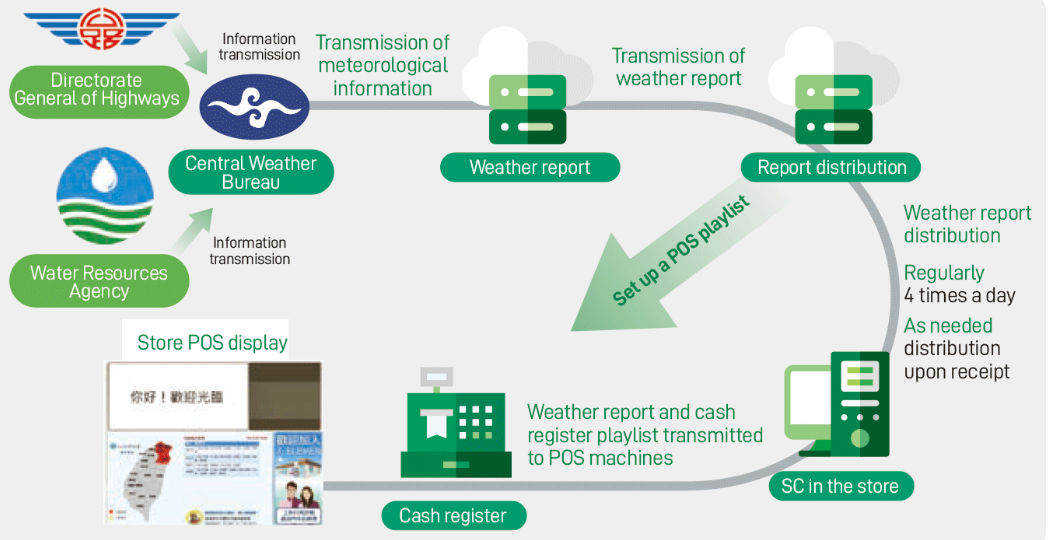
Schematic Diagram of Weather Information Distribution System
Industrial Transformation
| Risk / Opportunity Category |
Risk / Opportunity Description |
Timeline |
Changes to Business Model and Resource Allocation |
Method of Resource Provision |
| Transition Risk-Policy and Legal Risks |
Requirements and regulation of existing products and services |
Current |
- Engage external consultants to support and introduce carbon inventory operations, preliminary work for IFRS S1 / S2 indicator disclosure, and carbon reduction projects
- Introduce store equipment to reduce plastic use, including Intelligent automatic recycling machines, coffee sealing machines, and ice makers
- Introduce sustainable product packaging materials and containers, including fresh food products with rPET packaging, OPEN iECO® recycled cups, and 100% recycled plastic shopping bags
- Gradually replace high-energy-consuming equipment, including transportation vehicles, air-conditioning equipment, chillers, refrigerators, and lighting, and introduce renewable energy equipment
- Design consumer incentives for plastic reduction, including discounts for consumers who bring their own beverage cups, and plan long-term campaigns to promote recycled cup rentals
|
Internal operating expenses or capital expenditures |
| Anticipated |
- Introduce GHG inventories
- Introduce fresh food products with rPET packaging
- Identify practical ways to improve the sustainability of operations, such as sustainable packaging, expanded supply of alternative materials, and collaboration with suppliers to improve environmental practices
- Fully phase out plastic shopping bags and plastic straws
- Increase the use of recycled plastic products, with recycled cups and Intelligent automatic recycling machines as the main focus
- Procure renewable energy
|
Internal operating expenses or capital expenditures |
In response to the government's continued promotion of plastic reduction measures and increasingly stringent regulatory and information disclosure requirements, President Chain Store Corporation restricts single-use plastic products and proactively adjusts its product strategies and service offerings to ensure compliance with regulatory requirements, mitigate potential compliance risks, and maintain market competitiveness. Based on Taiwan's relevant laws and policy scenarios, President Chain Store Corporation assesses the potential financial impacts in the reporting year and over the short-, medium-, and long-term arising from non-compliance with greenhouse gas inventory requirements, IFRS sustainability disclosure standards, and product raw material regulations, and conducts financial impact analysis of carbon fees for future scenarios. For detailed analysis results of each scenario, please refer to the 2025 Sustainability Report.
Energy Transformation
| Risk / Opportunity Category |
Risk / Opportunity Description |
Timeline |
Current and Expected Changes to Business Model and Resource Allocation |
Method of Resource Provision |
| Opportunity |
Adoption of more efficient transportation methods |
Current |
- Purchase of Phase VI vehicles
- Introduction of dual-temperature logistics vehicles
- Distribution automation equipment
- Adjustment of warehousing locations
|
Internal operating expenses, capital expenditures, and external financing |
| Anticipated |
- Purchase of Phase VI vehicles
- Maintenance and repairs
- Distribution automation equipment
- Adjustment of warehousing locations
- Introduction of an Internal Carbon Pricing system: internalizing carbon emission costs in investment and operating decisions
- Providing “green delivery options” and encouraging consumers to support low-carbon logistics through pricing or membership mechanisms
|
Internal operating expenses, capital expenditures, and external financing |
According to the Ministry of Environment’s Phase II Greenhouse Gas Reduction Promotion Plan (2021–2025), the transportation sector should improve the energy efficiency of transportation systems and vehicles. In line with national policies and its own strategic development, President Chain Store Corporation continuously upgrades its logistics equipment. We assess the fuel cost savings from replacing vehicles with eco-friendly models and the labor cost reductions from green warehousing for the reporting year and over the short-, medium-, and long-term. In addition to improving the energy efficiency of our logistics partners, President Chain Store Corporation continues to promote a number of energy-saving and carbon-reducing measures at its operating locations across Taiwan, gradually improving energy efficiency and reducing greenhouse gas emissions. For relevant details, please refer to the 2025 Sustainability Report.
- Introduction of renewable energy: In response to international carbon reduction trend and to reduce dependence on traditional energy sources, President Chain Store Corporation integrated the concept of renewable energy into the design of Yawan store by introducing solar photovoltaics. In 2025, the Company further introduced renewable energy use at the Daosheng, Songgao, and Hongtai Stores.
- Introduction of energy management system: Promote energy conservation and energy efficiency improvement at the head office and stores. In 2025, the head office building continued to hold ISO 50001 energy management system certification for two stores. Other locations also engage in energy management in line with the spirit and structure of the energy management system to continuously improve energy use.
- Store energy-saving measures and results: In order to effectively improve the energy efficiency of stores, President Chain Store Corporation has formulated basic requirements for equipment and store environment management for new stores by incorporating energy-saving measures such as heat insulation, energy-saving signboards, lamp reduction, reduction of window area, frequency conversion system and LED lamps, and indoor lighting management, as well as introducing the energy-saving windbreak room depending on the stores. Existing stores actively evaluate the feasibility of introducing various energy-saving measures and gradually replace with high-efficiency equipment.
- Introduction of Internal Carbon Price mechanism: In order to strengthen our own operational carbon reduction management, President Chain Store Corporation introduced an internal carbon pricing mechanism in 2024, prioritizing the management of Scope 2 greenhouse gas emissions based on shadow price. According to the carbon price announced by the Ministry of Environment in 2024, the internal carbon price has been set at NT$300/ metric ton CO2e. Internal carbon pricing is mainly used to manage Scope 2 emissions related to purchased electricity. It is hoped that internal carbon pricing will encourage energy saving and carbon reduction actions to improve energy efficiency. Starting from 2024, President Chain Store Corporation took internal carbon pricing into consideration for major investment and procurement, as well as conducting cost-benefit analysis, such as evaluating the payback period of equipment investment and making a comprehensive comparison of the total cost after adding internal carbon pricing. To ensure that investment projects follow carbon reduction management targets, the subsequent plan is including internal carbon pricing in management reports to track changes in greenhouse gas emissions. The implementation of internal carbon pricing also helps us consider climate issues in our business strategies with an impact on key financial planning. In addition, although President Chain Store Corporation has not yet been included as a target under the government's regulations, the implementation of internal carbon pricing can also cope with potential financial impacts brought about by future regulations in advance.
Life Transformation
As one of the industries closest to people’s everyday life, the retail industry has to assist consumers with transforming their lives. Just like our slogan “Planet Sustainability In Our Everyday Life,” our life transformation strategy is guided by two major approaches — strengthening communication and education for consumers and stakeholders, and enhancing advocacy and cooperation with supply chains and partners — the Company continues to listen to and gather views from internal and external stakeholders. In terms of the supply chain, we have begun to inventory the greenhouse gas emissions of all raw material suppliers and OEMs , incorporating them into our Scope 3 upstream procurement calculations. Concurrently, we collect information on the energy-saving and carbon-reduction measures from our suppliers of private-label products and their energy-saving solutions for raw material procurement to monitor the effectiveness of carbon reduction efforts across the supply chain. The assessment results of 2025 indicate that 143 of the 184 raw material suppliers of private-label products have implemented energy-saving and carbon-reduction measures, representing 77% of the supplier base. Going forward, we will continue to encourage suppliers to strengthen their energy-saving and carbon-reduction efforts, enhance overall supply chain carbon management capabilities, and work collaboratively to reduce Scope 3 greenhouse gas emissions, thereby accelerating the transition toward a low-carbon supply chain. In advancing its net-zero transition plan, President Chain Store Corporation incorporates the concept of a just transition. Through internal training on various sustainability issues, the Company enhances employees’ ESG awareness and job skills, while taking social impacts into account throughout the net-zero transition process. It is committed to creating a low-carbon circular ecosystem covering the upstream, midstream, and downstream value chain, and to helping society as a whole move toward a net-zero future. For details on specific actions, please refer to the 2025 Sustainability Report.
- External Initiatives and Consumer Engagement
- President Chain Store Corporation integrates store employees, consumers and external partners in the value chain to promote knowledge on carbon reduction, plastic reduction, food waste reduction, etc. through “Good Neighbor Funfest” activities to promote communication with consumers on sustainable concepts.
- In 2025, a total of 884 “Good Neighbor Healthcare Funfests” were organized with blood donation, blood pressure measurement, waist measurement, health seminar, health education for the physically- and mentally-challenged, healthcare for elders and the disadvantaged, OPEN! CARES, etc. for over 13,000 participants. The goal is hosting 2,000 sessions in 2025 and 2026.
- Participation in Industry Associations and Lobbying Activities
President Chain Store Corporation is committed to managing the risks of the climate change transition and that all climate lobbying activities should be consistent with the Paris Agreement and the goal of limiting global temperature rise to a maximum of 1.5⁰C compared with pre-industrial levels. The scope of this commitment applies to President Chain Store Corporation and its subsidiaries, as well as to all areas in which it operates.
In order to ensure that direct and indirect climate change lobbying in each region is consistent with the goals of the Paris Agreement, the public policies implemented by industry associations and lobbying activities that we participate in are reviewed annually. If the policies involve climate change issues, the Company and its subsidiaries should determine whether the Paris Agreement has been violated. If it violates the aforementioned provisions, the Company will communicate the results with the relevant public policy planning units or industry associations within six months to decide whether to continue participating in the industry association (including withdrawing financial support suspension or termination of membership).
In addition, when participating in industry associations and lobbying activities, the Company abides by relevant laws and regulations, explains the reasons for participating in industry associations and lobbying activities, and follow the Company and its subsidiaries’ internal evaluation procedures before reporting to the President or above for approval. The result of participating industry associations and lobbying activities is disclosed each year. The following is the actual result of participating in industry associations and activities:
- Ministry of Economic Affairs: Take part in micro-carbon offsets to replace store lighting with LED, and submit the amount of carbon reduction verified by BSI to the Ministry of Environment for review.
- Ministry of the Interior: Engage in “Store Energy Consumption Classification.” President Chain Store Corporation supports the government’s building energy saving and carbon reduction policies as the first convenience store to receive the “Nearly Zero Carbon Building” label issued by the Ministry of Interior.
- Ministry of Environment: Participate in the discussion and practice of the environmental protection and plastic reduction project on outlying islands and the “Good Service Guidelines for Recycled (Rented) Cups.”
-
2025 Initiative: Earth Hour
Initiated by the World Wide Fund for Nature (WWF), "Earth Hour" is the world's largest environmental and energy-saving movement, raising public awareness of environmental sustainability by turning off lights for one hour. President Chain Store Corporation has been an active respondent since 2022. In 2024, it was officially authorized internationally, becoming one of the first local retailers in Taiwan to be an official organizer for "Earth Hour." In 2025, it expanded overseas, inviting over 4,100 stores in the Philippines to join the initiative, creating the "largest-scale lights-off event by a multinational convenience store chain in Asia." President Chain Store Corporation brought together the Ministry of Environment, Uni-President Enterprises Corporation, 7-ELEVEN Philippines, and over 540 global sustainability partners and affiliated enterprises to turn off their lights together for one hour from 20:30-21:30 on Saturday, March 22nd. A total of approximately 15,000 locations participated in the lights-off event. According to the latest electricity saving records from Taipower, electricity usage was reduced by about 298,000 kW during that hour, cutting carbon dioxide emissions by approximately 150 metric tons. This is equivalent to the carbon absorption of Daan Forest Park over 139 days.